Building a Business Case for Additive Manufacturing
Why the best additive manufacturing decisions are driven by business outcomes, not technology enthusiasm.
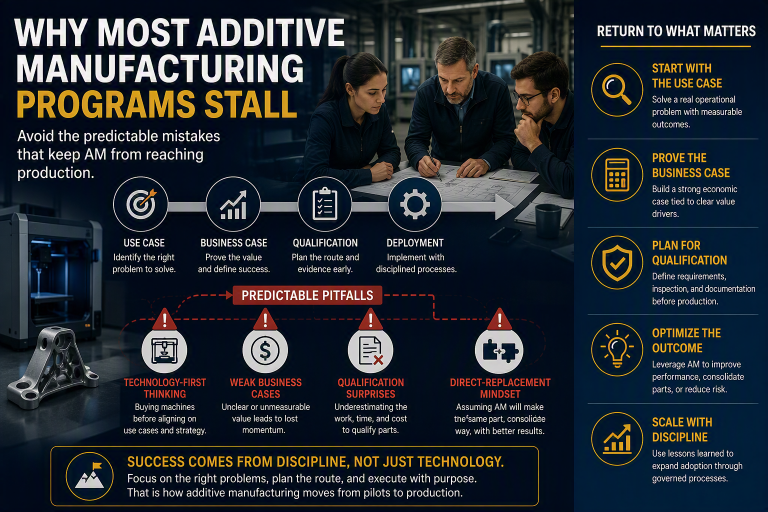
One of the most common mistakes organizations make when evaluating additive manufacturing is focusing on technology before evaluating business value.
Discussions often begin with printers, materials, build rates, and machine specifications. While those factors matter, they rarely determine whether an additive manufacturing initiative ultimately succeeds.
Successful programs begin with a different question:
What business problem are we trying to solve?
Additive Nexus
When organizations start there, additive manufacturing becomes a tool for achieving specific outcomes rather than a technology searching for a use case.
The Cost-Per-Part Trap
Many AM evaluations begin and end with a comparison of manufacturing costs.
While cost-per-part is important, it rarely captures the full value proposition.
A part that costs more to manufacture may still create significant value if it:
- Reduces lead time from months to days
- Avoids costly asset downtime
- Eliminates obsolete inventory challenges
- Reduces inventory carrying costs
- Improves supply chain resilience
- Enables localized production
In many industrial environments, the cost of waiting exceeds the cost of manufacturing.
Looking Beyond Manufacturing Cost
Strong business cases evaluate value across multiple dimensions.
Operational Value
Improved responsiveness, reduced downtime, faster sourcing, and increased operational flexibility.
Financial Value
Reduced inventory costs, avoided procurement expenses, lower logistics costs, and improved asset utilization.
Strategic Value
Improved resilience, supply security, workforce capability development, and future manufacturing flexibility.
Capability Value
The ability to support future initiatives through digital inventory, qualification frameworks, and manufacturing readiness improvements.
Common Sources of Value
Organizations often discover that additive manufacturing creates value in areas that are not immediately visible in traditional cost analyses.
- Spare parts availability
- Inventory reduction
- Obsolescence mitigation
- Tooling elimination
- Maintenance responsiveness
- Supply chain diversification
- Reduced transportation requirements
- Part consolidation opportunities
The strongest use cases frequently combine several of these value drivers simultaneously.
Not Every Application Is a Good Candidate
One of the goals of business-case development is identifying where additive manufacturing does not create meaningful value.
Some applications are best served by conventional manufacturing methods. Others may require additional technical maturity before they become economically attractive.
A strong business case helps distinguish promising opportunities from technology demonstrations.
The objective is not to justify additive manufacturing. The objective is to determine where additive manufacturing creates measurable business value.
A Structured Evaluation Process
- Identify candidate applications and operational challenges.
- Assess technical feasibility and manufacturing readiness.
- Quantify operational, financial, and strategic value.
- Prioritize opportunities based on impact and implementation effort.
- Validate assumptions through focused pilot activities.
- Scale successful initiatives into repeatable capability.
This approach creates an evidence-based pathway from opportunity identification to implementation.
Looking Forward
As additive manufacturing continues to mature, the organizations that realize the greatest value will be those that evaluate opportunities through the lens of business outcomes rather than technological novelty.
The future of additive manufacturing adoption will be driven less by what the technology can do and more by what it helps organizations achieve.
The best manufacturing investments solve business problems first and technology problems second.
Additive Nexus
Organizations that approach additive manufacturing through business-case development are more likely to identify high-value opportunities, align stakeholders, and build sustainable capability.