From Experimentation to Industrial Capacity
Why additive manufacturing success has far more to do with readiness, governance, and execution than printers.
For more than a decade, additive manufacturing has been promoted as a transformative technology. Organizations have invested in equipment, tested materials, and conducted pilot projects across industries ranging from energy and defense to aerospace and industrial manufacturing.
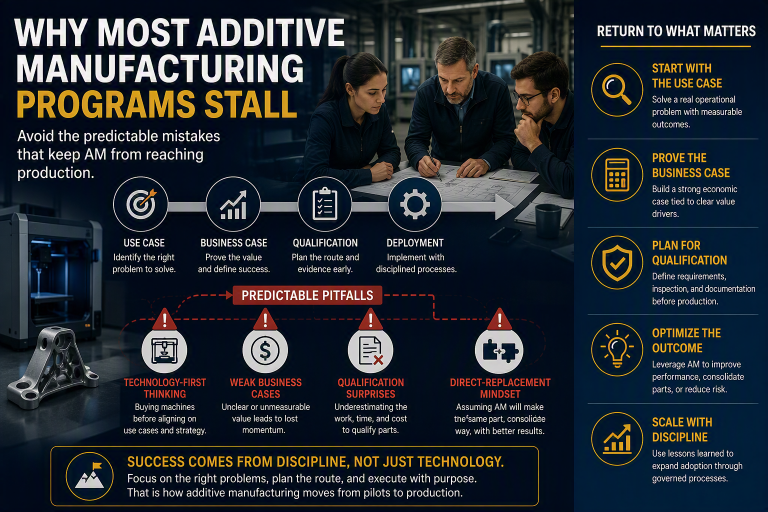
Yet despite significant progress, many initiatives struggle to move beyond experimentation. Pilot projects demonstrate technical feasibility, but the transition to repeatable operational capability often remains elusive.
The reason is surprisingly simple: manufacturing capability cannot be purchased.
Organizations do not achieve manufacturing transformation by buying technology. They achieve it by building capability.
Additive Nexus
The Technology Trap
Many organizations begin their additive manufacturing journey by focusing on equipment, materials, and production processes.
These are important considerations, but they are rarely the primary reason a program succeeds or fails.
Before an organization can reliably produce a part, it must answer a series of fundamental questions:
- Which applications create measurable value?
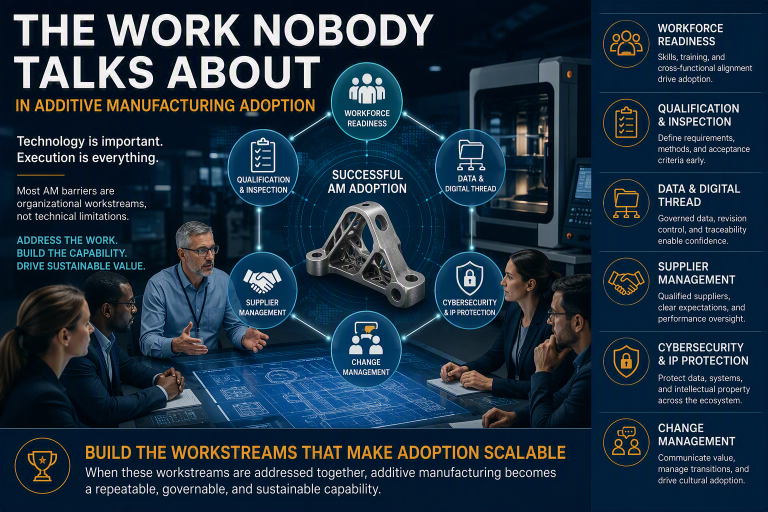
- How will quality be maintained?
- What qualification evidence is required?
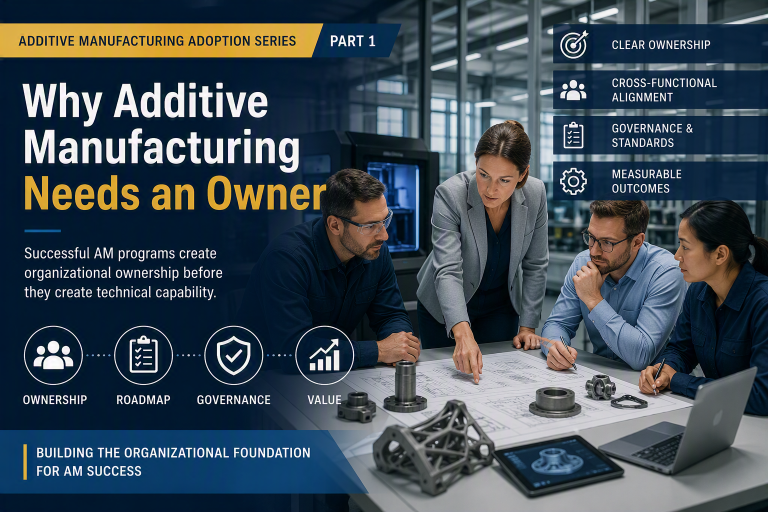
- Who owns approval authority?
- How will engineering information be controlled?
- How will suppliers be qualified?
- How will production be governed?
Without clear answers to these questions, even the most advanced technology can struggle to deliver sustainable business value.
The Journey to Industrial Capacity
Successful manufacturing programs typically evolve through a series of stages rather than a single transformational event.
- Awareness – Understanding what the technology can and cannot do.
- Assessment – Evaluating business cases and identifying candidate applications.
- Pilot – Validating technical feasibility and operational assumptions.
- Qualification – Establishing evidence, governance, and production readiness.
- Scale – Creating repeatable capability supported by processes, suppliers, and organizational ownership.
Organizations that successfully scale additive manufacturing recognize that each phase requires different decisions, different stakeholders, and different measures of success.
Capability Requires More Than Production
The most successful manufacturing programs connect multiple capabilities into a cohesive operating model.
Adoption
Creating alignment, identifying opportunities, and establishing implementation pathways.
Digital Inventory
Transforming technical information into governed digital assets.
Traceability
Managing qualification evidence, approvals, and digital information.
Readiness
Preparing parts, suppliers, and processes for production.
Distributed Manufacturing
Evaluating where manufacturing capability creates the greatest value.
Value Realization
Ensuring operational outcomes support strategic objectives.
Each capability reinforces the others. Missing one often creates the bottleneck that prevents meaningful scale.
The Shift from Parts to Capability
Many early additive manufacturing discussions focused on individual parts.
Today, leading organizations are increasingly focused on capability.
Instead of asking:
- Can we print this part?
They are asking:
- How do we create resilient supply chains?
- How do we reduce downtime?
- How do we manage qualification?
- How do we build trusted digital inventories?
- How do we scale production responsibly?
Those questions lead to capability development rather than isolated technology demonstrations.
Looking Forward
The future of manufacturing will not be defined solely by additive manufacturing machines, material innovations, or production technologies.
It will be defined by organizations that successfully connect digital information, qualification, governance, supply chains, and manufacturing execution into a repeatable operational capability.
In that future, additive manufacturing becomes one component of a much larger transformation—not the destination itself.
The organizations that create the greatest value from additive manufacturing will not be those with the most machines. They will be those that build the strongest manufacturing capability.
Additive Nexus
The journey from experimentation to industrial capacity is not primarily a technology challenge. It is a capability challenge.