The Pilot Project Trap
Why many additive manufacturing initiatives never make it beyond the pilot phase.
Across nearly every industry, additive manufacturing programs begin with enthusiasm, promising use cases, and successful demonstration projects.
A prototype is produced. A replacement part is validated. A design is optimized. Technical feasibility is demonstrated.
Then progress slows.
Years later, many organizations still describe additive manufacturing as a promising technology even though it remains largely disconnected from daily operations.
This pattern appears so frequently that it deserves a name:
The pilot project trap.
Additive Nexus
A Successful Pilot Is Not the Same as a Successful Program
Pilot projects answer an important question:
Can this part be manufactured using additive manufacturing?
What they often fail to answer is:
- Can this process be repeated?
- Can quality be consistently maintained?
- Can the workflow scale?
- Can suppliers support demand?
- Can engineering data be governed?
- Can the organization sustain the capability?
Demonstrating feasibility and creating capability are two very different objectives.
Why Pilot Projects Stall
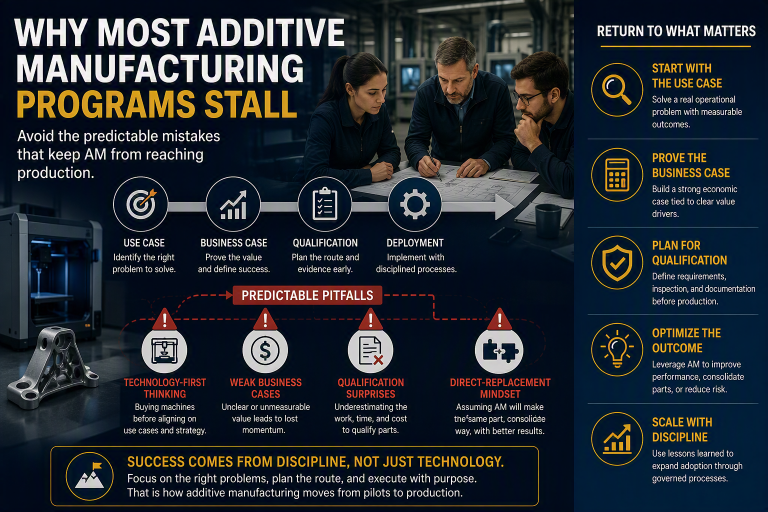
Technology is rarely the primary reason additive manufacturing programs stall.
More often, organizations encounter challenges related to readiness, governance, and alignment.
- No clearly defined adoption roadmap
- Limited executive sponsorship
- Undefined qualification pathways
- Insufficient engineering ownership
- Lack of digital inventory strategy
- Supplier readiness gaps
- Unclear business value
Each challenge may appear small in isolation. Together, they often prevent meaningful scaling.
The Missing Middle
Organizations often focus on two ends of the journey:
- Technology demonstration
- Large-scale production
The difficult work happens between those stages.
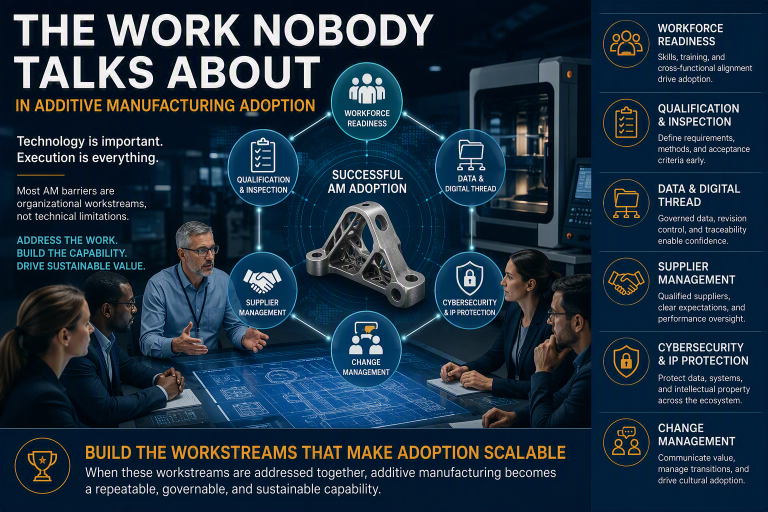
This “missing middle” includes:
- Application screening
- Business case validation
- Manufacturing readiness assessments
- Qualification planning
- Supplier engagement
- Governance development
- Digital information management
Organizations that invest in these activities are significantly more likely to move beyond isolated pilot projects.
Capability Is the Real Objective
Organizations often measure pilot success by technical outcomes.
A more useful measure is capability development.
A successful program creates:
- Repeatable workflows
- Qualified supply pathways
- Trusted engineering data
- Readiness frameworks
- Scalable governance
- Documented business value
These capabilities continue generating value long after a pilot concludes.
Questions Every Organization Should Ask
- What happens after the pilot succeeds?
- Who owns the capability?
- How will qualification be managed?
- How will suppliers be engaged?
- How will digital information be governed?
- Which business outcomes define success?
Organizations that answer these questions early reduce the risk of becoming trapped in pilot-mode indefinitely.
Looking Forward
The future of additive manufacturing will not be determined by how many pilot projects are completed.
It will be determined by how many organizations successfully convert pilot projects into enduring manufacturing capability.
Technology demonstrations prove what is possible. Capability development determines what becomes operational reality.
The goal is not to complete a pilot. The goal is to create capability that survives long after the pilot ends.
Additive Nexus