Why Additive Manufacturing Needs an Owner
Part 1 of the Additive Manufacturing Adoption Series
Successful additive manufacturing programs create organizational ownership before they create technical capability.
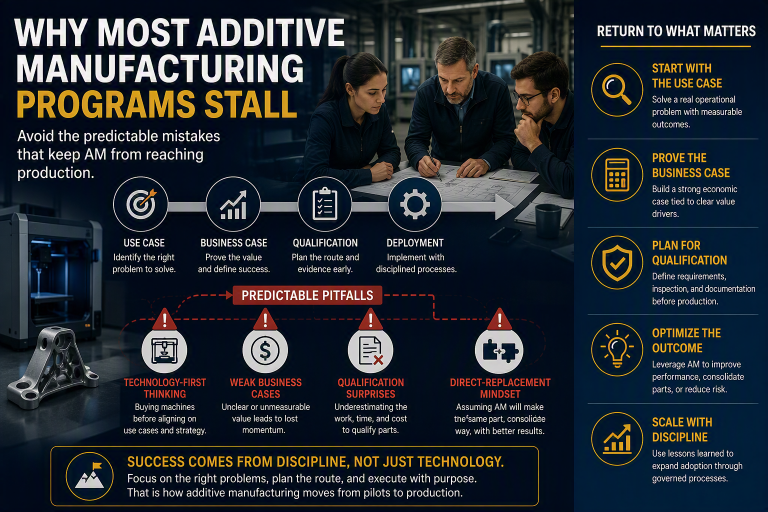
Most additive manufacturing programs do not fail because of the technology. They fail because nobody owns the adoption process.
A machine is purchased. A pilot is launched. A supplier demonstrates a compelling use case. Interest grows. Yet after the initial excitement, progress slows and adoption stalls.
Successful organizations eventually learn that additive manufacturing is not primarily a machine deployment project. It is an organizational transformation effort that requires ownership, coordination, governance, and long-term commitment.
Technology adoption succeeds when someone owns the journey, not just the equipment.
Additive Nexus
The Missing Ingredient in Many AM Programs
Many organizations invest significant effort evaluating equipment, suppliers, materials, and applications. Far fewer spend the same amount of time deciding who owns additive manufacturing as a capability.
Without clear ownership, AM activities often become fragmented. Different departments pursue independent projects using different suppliers, documentation methods, qualification approaches, and success criteria.
The result is usually a collection of disconnected accomplishments rather than a repeatable organizational capability.
Additive manufacturing requires a focal point that coordinates efforts across the company and provides continuity beyond individual projects or personnel changes.
What an AM Center of Excellence Actually Does
Many people associate a Center of Excellence with administration and bureaucracy. Effective AM Centers of Excellence serve a very different function.
Their job is not to own every additive manufacturing project. Their job is to own the connective work that allows additive manufacturing to scale.
- Roadmap development and portfolio management
- Application intake and screening
- Qualification frameworks and standards alignment
- Supplier evaluation and engagement
- Training and workforce development
- Knowledge capture and lessons learned
- Adoption metrics and governance
Think of the Center of Excellence as connective tissue. It links engineering, quality, procurement, operations, supply chain, maintenance, and leadership around a common adoption framework.
The Center of Excellence does not own every printed part. It owns the system that allows adoption to scale.
Three Questions Every AM Program Must Answer
1. Where Are We Going?
Someone must own the roadmap. Which applications matter most? Which business problems are worth solving? How will success be measured?
2. How Will We Get There?
Someone must coordinate standards, qualification paths, supplier strategies, and implementation methods so that projects do not operate independently.
3. What Have We Learned?
Every AM project generates knowledge. If those lessons remain isolated within individual teams, the organization repeatedly solves the same problems. Ownership creates institutional memory.
What Should Be Centralized?
Not every decision belongs in a Center of Excellence. However, several functions benefit from centralized ownership.
- Portfolio management and candidate prioritization
- Qualification and governance frameworks
- Supplier-management strategy
- Training and workforce development
- Knowledge management and reusable assets
These capabilities become more valuable when managed consistently across the organization.
What Should Remain Local?
The purpose of an AM Center of Excellence is not to centralize every decision.
Business units and operational teams should continue to own:
- Application ownership
- Asset-specific priorities
- Maintenance requirements
- Operational decision making
- Business-case accountability
A useful principle is simple:
Centralize guidance. Distribute execution.
The Roadmap Comes Before the Machine
One of the most common mistakes in AM adoption is discussing equipment before discussing ownership.
Machines do not create application pipelines. Machines do not establish qualification frameworks. Machines do not coordinate suppliers, engineering teams, quality organizations, or procurement processes.
Ownership comes first.
The most successful organizations focus on use cases, governance, readiness, and adoption pathways before they focus on machine specifications.
Before You Build Capability, Build Ownership
Successful additive manufacturing programs eventually reach the same conclusion: technology alone is not enough.
Applications matter. Qualification matters. Suppliers matter. Data matters. Workforce readiness matters.
But none of those can scale without ownership.
The organizations that achieve repeatable additive manufacturing capability establish a focal point responsible for roadmap development, portfolio management, training, governance, supplier engagement, and knowledge capture.
The organizations that succeed are not necessarily the ones with the most printers. They are the ones that create clear ownership for adoption.
Additive Nexus
What Comes Next?
Ownership alone does not create adoption.
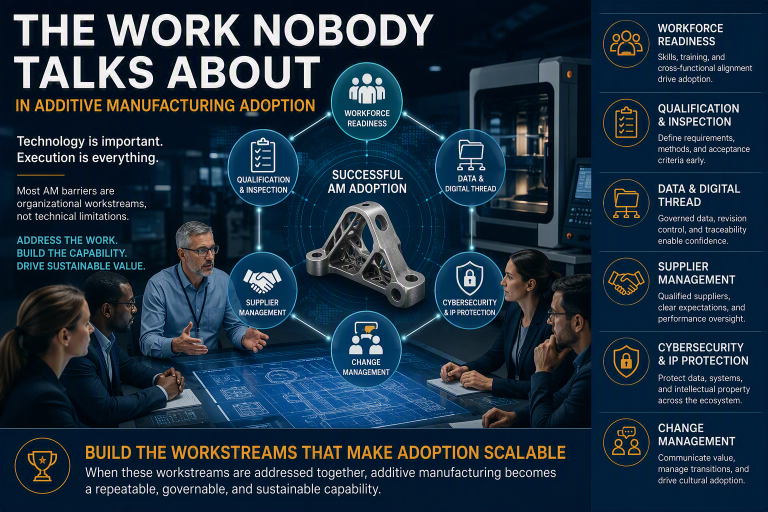
Many organizations assume the largest barriers to additive manufacturing are technical. In reality, the most difficult work often involves workforce readiness, qualification, supplier management, inspection capability, data governance, cybersecurity, and organizational change.
In Part 2 of this series, we examine the work nobody talks about in additive manufacturing adoption and explain why most barriers are organizational workstreams rather than technology limitations.
Next: The Work Nobody Talks About in Additive Manufacturing Adoption