The Work Nobody Talks About in Additive Manufacturing Adoption
Part 2 of the Additive Manufacturing Adoption Series
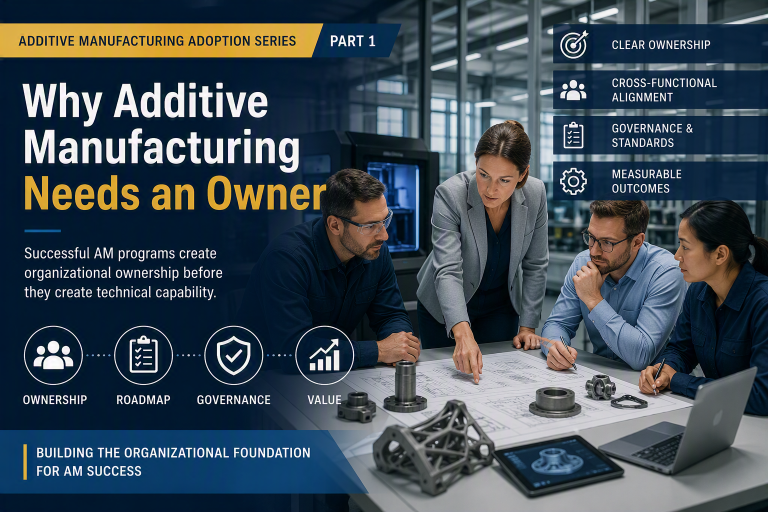
In Part 1, Why Additive Manufacturing Needs an Owner, we explored why successful AM programs establish ownership before they attempt to scale capability.
Once ownership exists, the next challenge becomes understanding the work itself. This is where many organizations discover that additive manufacturing adoption is far less about equipment than they initially expected.
Most additive manufacturing barriers are organizational workstreams, not technology limitations.
Ask someone why additive manufacturing adoption is difficult and the conversation usually turns toward machines, materials, software, or production processes.
Those challenges certainly matter. But organizations that have successfully implemented additive manufacturing often discover that the most difficult obstacles are not technical at all. They are organizational.
Workforce readiness. Qualification. Inspection. Data governance. Supplier management. Cybersecurity. Procurement processes. Change management.
These are the workstreams that determine whether additive manufacturing remains an interesting pilot activity or becomes a sustainable capability.
Machines are easy to buy. Capability is harder to build.
Additive Nexus
The Hidden Work Behind Adoption
Many additive manufacturing initiatives begin with a promising application. The part appears printable. The business case looks attractive. Leadership is supportive.
Then the questions begin.
- Who approves the design?
- How will suppliers be qualified?
- What inspection method is acceptable?
- How will digital files be controlled?
- Who owns the material data?
- What records must be retained?
- How will cybersecurity requirements be addressed?
- What training is required?
None of these questions can be answered by a machine purchase. They require organizational decisions.
This is why additive manufacturing should be viewed as a business capability rather than a production technology.
Workstream #1: Workforce Readiness
One of the most common adoption barriers is the assumption that additive manufacturing only affects a small technical team.
In practice, AM often touches engineering, operations, procurement, supply chain, quality, maintenance, and leadership functions.
Each group needs a different level of understanding.
- Leadership needs business-case literacy.
- Engineering needs application-fit knowledge.
- Quality teams need qualification awareness.
- Procurement needs supplier evaluation criteria.
- Operations needs implementation plans.
Organizations frequently underestimate how much education is required to create alignment across these functions.
Workstream #2: Qualification and Inspection
Many AM discussions focus on printing. Far fewer focus on proving that the resulting part is acceptable for use.
This is where qualification and inspection become critical.
Organizations need clear answers to questions such as:
- What evidence is required?
- Who approves the qualification path?
- What inspection methods are acceptable?
- What documentation must be retained?
- Which standards apply?
Qualification cannot be treated as an afterthought. It must be planned from the beginning of the adoption journey.
The best time to discuss qualification is before the first part is printed.
Workstream #3: Data and the Digital Thread
Every additive manufacturing program eventually becomes a data-management challenge.
Files must be stored, managed, revised, protected, and distributed. Technical authority must be preserved. Access rights must be controlled. Digital records must be maintained.
Organizations pursuing digital inventory, distributed manufacturing, or supplier networks face even greater complexity because files become part of a broader supply workflow.
The digital thread is often discussed as a technology topic, but it is fundamentally a governance topic.
Workstream #4: Supplier Qualification
Few organizations intend to perform every aspect of additive manufacturing internally.
Most depend on suppliers, contract manufacturers, material providers, inspection services, or engineering partners.
The challenge is establishing consistent criteria for selecting and evaluating those partners.
- What capabilities are required?
- How will performance be assessed?
- What records must be maintained?
- Who approves suppliers?
- What happens when suppliers change processes or equipment?
Without supplier governance, additive manufacturing programs become difficult to scale and difficult to defend.
Workstream #5: Cybersecurity and Intellectual Property
Digital manufacturing changes the way design information moves through an organization.
That creates important questions about ownership, access, file control, and cybersecurity.
The objective is not simply to protect files. It is to ensure that only authorized parties can access, modify, distribute, or manufacture controlled technical data.
Organizations that address these questions early reduce risk while making future scaling easier.
Workstream #6: Change Management
Perhaps the most overlooked barrier is change management.
Additive manufacturing often challenges established assumptions about supply chains, inventory, procurement, manufacturing, quality, and repair.
People may not resist the technology itself. They may resist the changes required to integrate the technology into existing workflows.
Successful organizations treat change management as a planned activity rather than a side effect of implementation.
Adoption happens when people trust the process, not when they are merely exposed to the technology.
Turn Barriers Into Workstreams
A useful mindset is to stop treating barriers as obstacles and start treating them as workstreams.
Every challenge should have:
- An owner
- A decision gate
- A required body of evidence
- A defined path to resolution
When barriers are addressed this way, they become manageable. The organization can see progress, assign accountability, and reduce surprises later in the adoption process.
Technology Is Not the Hard Part
Modern additive manufacturing technology is capable, mature, and increasingly accessible.
The real challenge is creating the organizational capability required to use it repeatedly, responsibly, and at scale.
Organizations that succeed recognize that workforce readiness, qualification, data governance, cybersecurity, supplier management, inspection, and change management are not side topics.
They are the work.
The future of additive manufacturing adoption depends less on better machines and more on better organizational execution.
Additive Nexus
What Comes Next?
Even organizations that establish ownership and address the major adoption workstreams can still struggle.
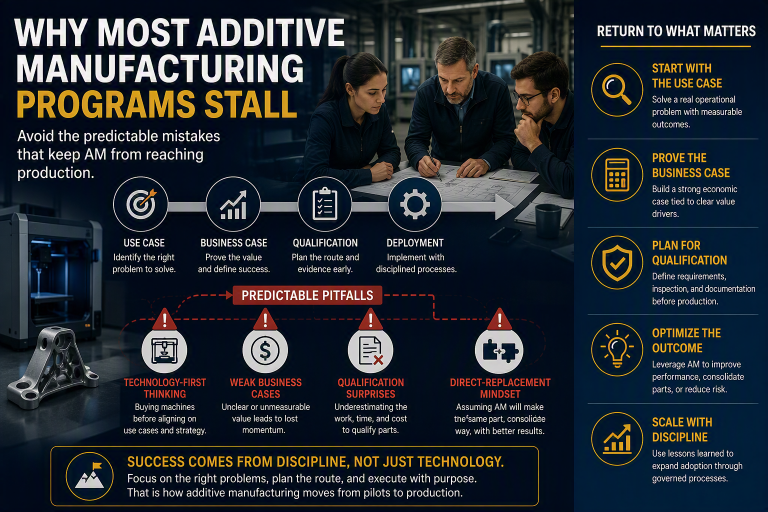
The reason is often surprisingly simple: they fall into predictable traps.
Technology-first thinking. Weak business cases. Qualification surprises. Direct-replacement assumptions.
In Part 3, we explore the most common failure modes in additive manufacturing adoption and explain how to avoid them before they derail progress.