Why Most Additive Manufacturing Programs Stall
Part 3 of the Additive Manufacturing Adoption Series
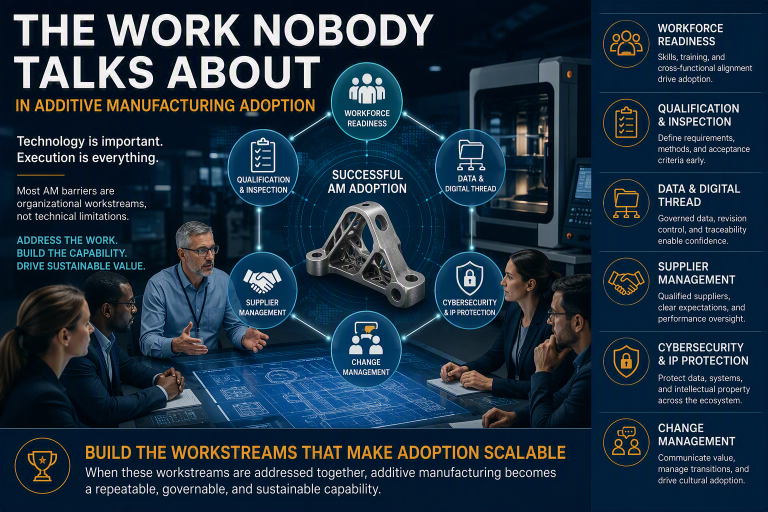
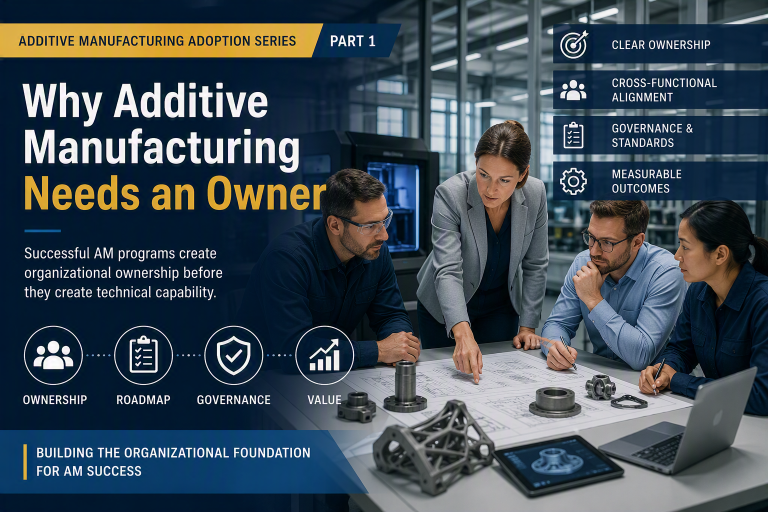
In Part 1, we discussed why additive manufacturing needs clear ownership. In Part 2, we explored the organizational workstreams that determine whether adoption can scale.
This final article focuses on the failure modes that repeatedly appear in additive manufacturing programs.
Most additive manufacturing programs do not fail because of the technology. They fail because organizations make the same predictable mistakes.
The encouraging news is that these pitfalls are neither new nor mysterious. They are visible, repeatable, and largely preventable.
The most successful AM programs learn to recognize these warning signs early and use them as signals to return to the original use case, business objective, and qualification requirements.
When an additive manufacturing program stalls, the problem is rarely the printer. The problem is usually the path that led to the printer.
Additive Nexus
The Most Dangerous Assumption in AM Adoption
Organizations often assume that additive manufacturing adoption follows a straightforward path:
- Acquire capability
- Print parts
- Generate savings
- Scale deployment
Real adoption rarely works this way.
Successful programs move through cycles of screening, validation, qualification, learning, governance, and organizational adaptation. When those activities are overlooked, predictable failures begin to emerge.
The purpose of this article is not to discourage additive manufacturing adoption. It is to help organizations avoid avoidable mistakes.
Pitfall #1: Technology-First Thinking
The most common adoption mistake is starting with technology rather than with a use case.
A machine becomes the strategy.
Organizations become excited about equipment capabilities before they have:
- A qualified application pipeline
- Defined business outcomes
- A prioritization process
- Ownership and governance
- A clear path to deployment
This often produces a difficult question six months later:
Now that we have the machine, what should we do with it?
High-performing organizations reverse the sequence.
They start by identifying business problems worth solving and then evaluate whether additive manufacturing is the best route to the desired outcome.
Pitfall #2: Weak Business Cases
A surprising number of additive manufacturing projects are based on technical possibility rather than business value.
The fact that a part can be printed does not mean it should be printed.
Strong AM programs focus on measurable outcomes such as:
- Lead-time reduction
- Downtime avoidance
- Inventory reduction
- Assembly consolidation
- Repair economics
- Performance improvement
- Material optimization
- Supply-chain resilience
Without measurable pain, leadership eventually loses interest because the value proposition remains unclear.
The strongest use cases usually combine multiple value drivers rather than relying on a single benefit.
The best AM business cases solve expensive problems, not interesting problems.
Pitfall #3: Qualification Surprises
Many organizations underestimate the amount of work required after a successful print.
Producing a part is only one step in a larger workflow.
The complete route may include:
- Heat treatment
- Machining
- Surface finishing
- Inspection
- Material verification
- Documentation
- Qualification records
- Approval processes
Organizations that discover these requirements late often experience schedule delays, cost overruns, or stakeholder frustration.
Qualification should be discussed before investment accelerates, not after the first successful build.
Many AM programs underestimate the route because they focus on the printing step instead of the entire production workflow.
Pitfall #4: Direct-Replacement Thinking
Another common mistake is treating additive manufacturing as a direct replacement for conventional manufacturing.
The assumption sounds reasonable:
We will print the same part and achieve the same result.
Unfortunately, this mindset often limits the value of additive manufacturing.
Successful programs ask a different question:
What is the better outcome?
That outcome may involve redesign, consolidation, repair, inventory reduction, improved logistics, better performance, or faster response.
The objective is not to replicate the legacy process. The objective is to improve the total system.
Pitfall #5: Treating Adoption as an Engineering Project
Engineering is essential, but adoption is broader than engineering.
Organizations that view AM exclusively as an engineering initiative often struggle to engage:
- Operations
- Quality
- Maintenance
- Procurement
- Supply chain
- Cybersecurity
- Leadership
As a result, technical success does not translate into organizational adoption.
The most successful programs treat additive manufacturing as an enterprise capability that requires participation from multiple stakeholders.
Pitfall #6: Failing to Capture Lessons Learned
Every AM initiative generates valuable knowledge.
Application screening criteria, supplier experiences, qualification approaches, inspection methods, economic assumptions, and workflow decisions all represent organizational assets.
When those lessons remain isolated inside individual projects, each new effort begins from the same starting point.
Mature AM organizations create systems for capturing and reusing knowledge so that every project strengthens the next one.
Adoption accelerates when experience becomes organizational knowledge rather than individual memory.
A Simple Self-Diagnostic
If your AM program is struggling to gain traction, ask these questions:
- Do we have a qualified application pipeline?
- Can we articulate measurable business value?
- Have we addressed qualification requirements early?
- Are we optimizing for outcomes rather than technology?
- Do multiple functions participate in adoption?
- Are lessons being captured and reused?
If the answer to several of these questions is no, the challenge is probably not technical capability.
The challenge is adoption readiness.
Return to the Use Case
The notes behind many successful AM implementations share a common theme: when programs encounter difficulty, the solution is often to return to the use case.
What problem are we solving?
Why does this application matter?
What evidence is required?
What outcome are we trying to improve?
When organizations repeatedly ask those questions, most adoption pitfalls become easier to identify and easier to avoid.
Successful additive manufacturing programs do not start with machines. They start with problems worth solving and build evidence one decision at a time.
Additive Nexus
Series Conclusion
Additive manufacturing adoption is not a technology project.
It is a capability-building journey.
Organizations that scale successfully establish ownership, address the critical workstreams, and avoid the predictable traps that derail progress.
The companies that win with additive manufacturing are rarely the ones with the newest equipment. They are the ones that create the strongest adoption system.